
News
Ahead of the EU decision: Also New Genetic Engineering must remain clearly identifiable
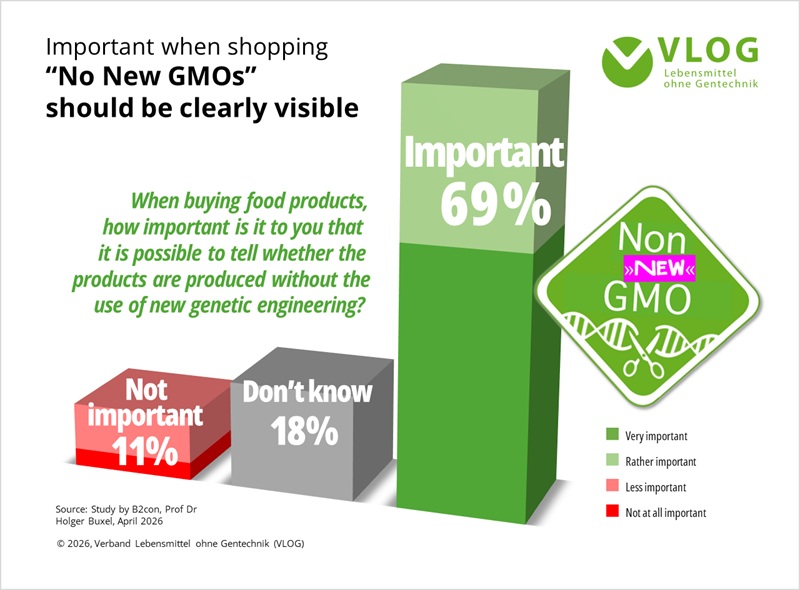
For 69 percent of consumers, it is important to be able to tell when buying whether food products have been produced without "new" genetic engineering. This is a preliminary finding from a broad-based, representative market research study conducted by Prof Dr Holger Buxel of Münster University of Applied Sciences on the topic of "New Genetic Engineering in food" on behalf of the Association Food without Genetic Engineering (VLOG) in spring 2026.
"So-called 'new' genetic engineering in food must also remain clearly identifiable in the future. MEPs must take this clear consumer mandate into account this week in the Environment Committee and during the final vote in Parliament by supporting the relevant amendments," comments VLOG Managing Director Alexander Hissting ahead of the votes scheduled for 15 June in the Environment Committee (ENVI) and for 17 June 2026 in the European Parliament on the new EU Regulation on New Genetic Technologies (NGT).
"If the new genetic engineering regulations were to be adopted now without amendments, consumers would in future only be able to be sure that products bearing the 'Ohne Gentechnik' (Non-GMO) or Organic seal have been produced without new genetic engineering. For food manufacturers and retailers, however, the effort required to ensure GMO-free status would increase significantly. This would represent an unfair shift of costs and burdens from GMO companies to the food industry," said Alexander Hissting.
In the current market research study on new genetic engineering in food conducted in April 2026, 44 percent answered the question "How important is it to you when buying food products that it is clear whether the products have been produced without new genetic engineering?" with "very important" and 25 percent with "somewhat important". Taken together, traceability is therefore "important" to more than two-thirds of the 1,057 respondents. A further 8 percent consider traceability "less important" and only 3 percent "not important at all". The relatively large proportion of 18 percent who are undecided is likely to be linked to the fact that not everyone is yet familiar with the topic of NGT.