
News
Expert publication: Protection rules for "Ohne Gentechnik" are compatible with EU law
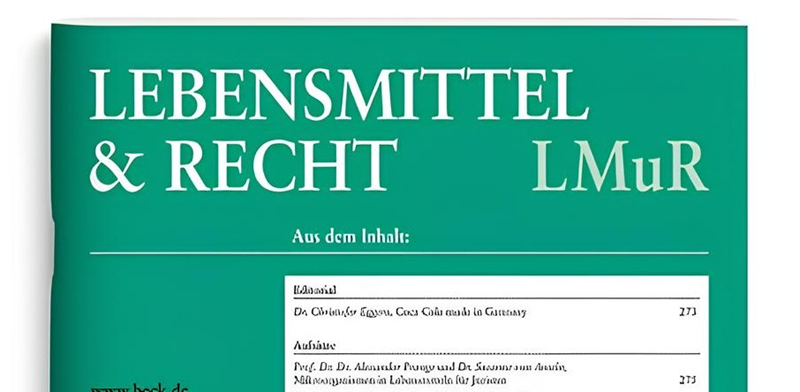
This is demonstrated in the new legal article "Coexistence with New Genetic Engineering – National Regulatory Discretion under the NGT Regulation" by Dr Georg Buchholz in the renowned expert journal "Lebensmittel und Recht" (Food and Law). The author had already set out in detail in July 2026, in an expert opinion for the Association Food without Genetic Engineering, that the existing national protective rules governing the cultivation of genetically modified crops – the so-called "coexistence measures" such as distance and information requirements, as well as site registers – can and must continue to apply to New Genetic Engineering (NGT) as well, particularly to the "NGT1" category.
When cultivating NGT1, these rules are particularly important for protecting "Ohne Gentechnik“ and organic produce from genetic contamination, as there will no longer be any labelling requirement beyond the seed for this newly defined category of genetic engineering. Nevertheless, they are still explicitly classified as "genetically modified organisms" (GMOs) under the law and must be excluded from organic and "Ohne Gentechnik“ production.
This is undisputed and has also been confirmed by the German Ministry of Agriculture (BMLEH). However, the Ministry has so far taken the view that "with regard to Category 1 NGT plants, there is no scope for national coexistence measures", as the NGT Regulation is a "fully harmonising legal act" that does not provide for "any explicit authorisation for Member States to enact coexistence measures".
In his new article, Dr Georg Buchholz, an expert in genetic engineering law, states that the Commission even explicitly assumes that there are non-harmonised areas for NGT-1 plants as well, by requiring Member States to take into account the equivalence of NGT-1 plants with conventional plants "when adopting national measures on non-harmonised aspects”.
According to the author, "only the national authorisation and mandatory labelling provisions are fully harmonised by the NGT Regulation". Otherwise, the Member States’ regulatory discretion is restricted only by the general rules on the primacy of Union law. "Therefore, national regulations on liability, coexistence and nature conservation for GMOs continue to apply to NGT-1 plants as well, provided that the national legislature does not expressly exempt these plants and Union law does not preclude this," says Dr Georg Buchholz.
Key points from the expert article “Coexistence with New Genetic Engineering – National Regulatory Discretion under the NGT Regulation” in Lebensmittel & Recht (LMuR) 5/2026
Following the adoption of the new EU NGT Regulation (NGT-VO), NGT1 organisms will continue to be regarded as genetically modified organisms (GMOs)
The NGT Regulation does not entail comprehensive "full harmonisation"; only the national authorisation and mandatory labelling requirements are fully harmonised by it
Even with the new NGT Regulation, many national rules on the coexistence of genetically modified organisms remain in effect:
- The liability rules for GMOs enshrined in German law also apply to NGT1 if an NGT1 introduction results in an infringement of property rights.- National measures to protect against the unintended presence of GMO introductions remain in effect. These measures include the obligation of those cultivating GMOs to inform neighbouring farms, and the requirement for the farm cultivating GMOs to comply with distance rules during cultivation.
- As long as NGT1 plants are not explicitly excluded from the scope of the provisions on the site register mentioned in in Section 16a of the Genetic Engineering Act (GenTG), its requirements therefore continue to apply to NGT1 plants as well.
- The NGT Regulation excludes a labelling requirement for NGT1 – with the exception of seed. Nevertheless, it is possible and advisable for national governments to establish regulations regarding a contractual duty to provide information, under which information on the NGT1 status of goods must be passed on along the supply chain.- Nature conservation regulations concerning GMOs in the Member States remain in effect for NGT1 as well. This applies, for example, to cultivation bans in certain nature conservation areas or to buffer zone requirements between GMO crops and such nature conservation areas.
LMuR – Food & Law, Issue 5/2026 (German)
Legal opinion: Existing protective rules also apply to New Genetic Engineering