
News
Consumers: Retailers should clearly label products "Without New Genetic Engineering"
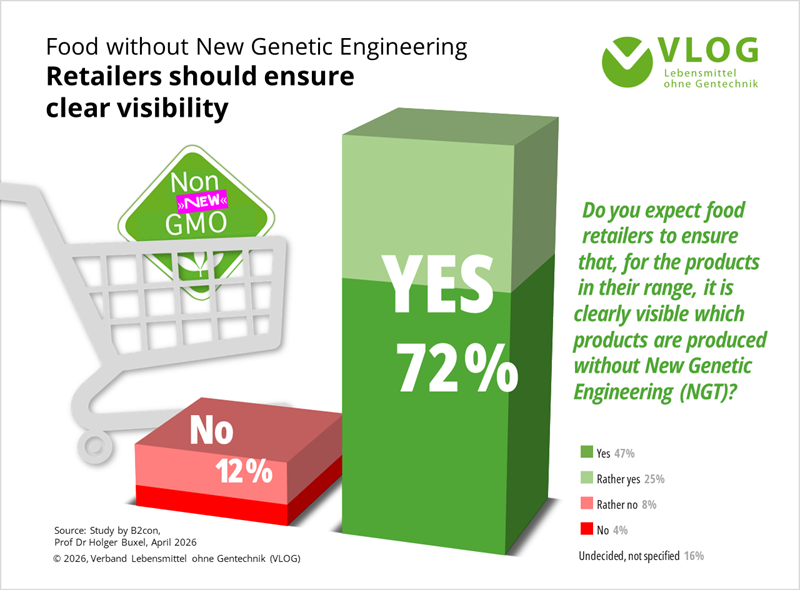
72 percent of consumers believe that retailers have an obligation to ensure transparency on supermarket shelves in this way in the future. This is a preliminary finding from a wide-ranging, representative market research survey conducted by Prof Dr Holger Buxel of Münster University of Applied Sciences on the topic of "New Genetic Engineering in Foodstuffs", commissioned by the Association Food without Genetic Engineering (VLOG) in spring 2026.
The new rules set out in the EU NGT Regulation, adopted in June 2026, must be applied from July 2028. Among other things, this will abolish the previous mandatory labelling requirement for genetically modified organisms (GMOs) for the newly defined category of "NGT1" plants. According to studies, this is likely to affect over 90 percent of future NGT products.
As a result, consumers may eventually find themselves unable to be certain – even when shopping for bread, beer, bananas or baby food – whether these products were produced using NGT. Following the abolition of the statutory labelling requirement, the option of voluntary "Ohne Gentechnik“ (Non-GMO) labelling remains, which also excludes all types of NGT, including NGT1 – the same applies to organic products. According to the study, most consumers now expect retailers to close this new statutory "labelling loophole".
In the market research study on new genetic engineering in food conducted in April 2026, 47 percent answered the question “Do you expect food retailers to ensure that, for the products in their range, it is clearly visible which products are produced without New Genetic Engineering (NGT)?” with “Yes” and 25 percent with “Rather yes”. Taken together, therefore, almost three-quarters of the 1,057 respondents believe retailers have a responsibility to ensure transparency regarding NGT in the future. 8 percent answered the question with “Rather no” and 4 percent with “No”. The relatively large proportion of 16 percent who were undecided suggests that the issue of NGT is still not widely known to everyone.