
News
New EU rules: "Ohne Gentechnik" will require a seal in the future
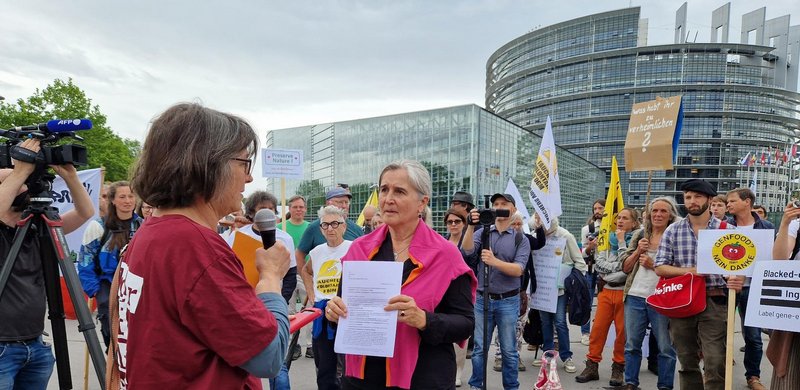
Farmer Barbara Endraß with Maria Noichl MEP (S&D) on 16 June 2026 in front of the EU Parliament, Photo: AbL
"It is disappointing that MEPs even waved through the widespread abolition of GMO labeling for food and failed to enforce an effective ban on seed patents - contrary to what the Parliament itself decided just two years ago," comments Alexander Hissting, Managing Director of the Association Food without Genetic Engineering (VLOG), which awards the green "Ohne GenTechnik" seal for foodstuffs.
"Now, the voluntary ‘Ohne Gentechnik’ and Organic seals must, and will, close this new legal labeling gap. This is because the vast majority of consumers want clarity, even regarding ‘new’ genetic engineering (NGT), on whether it was used in the production of their food. If genetic engineering could soon be present even in bread, beer, bananas, or baby food, an ‘Ohne Gentechnik’ label will become even more important in the future."
Up until now, foods containing genetically modified ingredients have always been required to indicate this in the ingredient list. Under the new regulations, this mandatory labeling requirement for genetically modified organisms will be eliminated in two years for a large portion of NGT. Approval procedures, risk assessments, and other safety measures for these genetically modified plants will also be abolished without further ado.
"The new rules make ‘Ohne Gentechnik’ production more difficult and time-consuming, but not impossible. We will rise to the challenges and adapt our standards accordingly to continue reliably excluding the use of NGT. Shifting this burden from the GMO companies, and thus from those responsible, onto the food industry is unfair and has, unfortunately, been largely ignored by the majority of Members of the European Parliament," said Alexander Hissting.
"Now, the German Minister of Agriculture Rainer must work with ‘Ohne Gentechnik’ and the Organic sector in Germany to adapt national GMO regulations so that they are protected from NGT contamination and can continue to successfully meet the high demand for GMO-free foods." Together, these two sectors sold approximately 36 billion euros worth of food in Germany in 2025.
The new EU rules for NGT are set to take effect after a two-year transition period. Until then, numerous technical and legal issues must be clarified, such as regulations on coexistence, documentation, liability, and verification procedures. The new regulations could even be completely challenged in court once again, as several legal opinions and, most recently, a sensational court ruling in the United Kingdom have already shown.
Ahead of the EU decision: Also New Genetic Engineering must remain clearly identifiable
Legal opinion: "Ohne Gentechnik" must also exclude New Genetic Engineering
Legal opinion: Planned deregulation of genetic engineering would be unlawful
Tagesschau: Labeling requirement eliminated - EU Parliament votes to erode GMO rules (German)
t-online: GMO soon to be sold on store shelves without labeling - What does that mean? (German)